
Understanding Uvalde County Releases
A release is an event, not one status shared by every agency. The Uvalde County Correctional Facility can record that a person left its control, while a court order states the legal reason. TDCJ may record a later release from state prison. A parole office may then document supervision in the community. The word means little unless it answers three points: which agency released the person, when the event occurred, and whether the person entered the community or another custodian's control.
That distinction is especially important in Uvalde. County audit material says the correctional facility houses local, area, and United States federal prisoners. Someone can leave the building on bond, after time served, or after dismissal processing. Another person may transfer to TDCJ, another county, the U.S. Marshals Service, or immigration custody. A transfer ends one booking but is not freedom from custody. For that reason, the sheriff's departure record should be read with the receiving-agency field and the court cause.
- Release
- Physical departure from one custodian, either to the community or another authority.
- Discharge
- Completion of a sentence or supervision obligation, not merely leaving a jail or prison.
- Parole
- Community supervision after TDCJ imprisonment under a Board decision.
- Probation
- Court-ordered community supervision administered by the local CSCD.
Uvalde County Release Outcomes
The recorded outcome determines the next useful source. Bond allows physical release while the case continues. It does not mean acquittal or dismissal. Time served usually rests on a judgment and credit calculation. A dismissal is a court disposition, but the jail entry is still needed to establish the time of departure. Probation may begin without any state-prison stay. Parole follows a TDCJ term. A hold or transfer points away from community release and toward the receiving agency.
| Recorded outcome | Meaning | Next record |
|---|---|---|
| Bond or personal bond | The person leaves while the charge remains pending. | Signed bond, court docket, and sheriff booking-out entry |
| Time served | The sentence or credit may permit release after processing. | Judgment, computation, and actual release time |
| Dismissal | A charge ends, though another cause or hold may remain. | Dismissal order and jail departure record |
| Probation | Community supervision begins or continues under the court. | Court docket and Uvalde County CSCD |
| Parole or mandatory supervision | TDCJ incarceration ends under state supervision. | TDCJ release certificate and Parole Division record |
| Transfer or detainer | Custody shifts to another agency. | Receiving agency, destination jail, BOP, ICE, or federal docket |
Uvalde County Release Record Fields
The most useful county proof is a named booking-out or release-and-transfer record tied to the jail register. Texas retention rules require the permanent register to include a release or transfer date. Related booking-in, booking-out, and release or transfer orders have a minimum retention period extending two years after departure. Those requirements do not promise that each item is published online or that every requested field is open without redaction.
| Field | What it establishes |
|---|---|
| Name, aliases, and intake number | Identity and the specific booking involved |
| Booking date and arresting agency | When the jail event began and who initiated it |
| Charge and cause number | The court file that should be checked |
| Bond or magistrate data | Terms affecting release while a case continues |
| Release or transfer date and time | When county custody for that booking ended |
| Release type or destination | Community departure versus an agency handoff |
| Booking photo and property receipt | Identity evidence and property processing tied to the stay |
A shorthand reason is not always the final legal answer. Reconcile it with the signed order and docket. A court disposition proves what happened in the case, while the jail record proves physical movement. When the two appear to conflict, preserve the status wording and timestamps, then ask both custodians about later orders or other holds.
Request Uvalde County Release Records
Uvalde County does not provide a verified online release archive. A precise Texas Public Information Act request is the dependable route. Send it to the Uvalde County Sheriff's Office at 339 King Fisher Lane, Box 1, Uvalde, TX 78801, or email sheriff@uvaldecounty.gov. The main number is 830-278-4111. Ask where requests are currently accepted before making an in-person trip because the official page does not state records-unit hours.
- Identify the person with full name, aliases, date of birth, intake number if known, and a narrow booking or release range.
- Name the records: jail-register entry, booking-in and booking-out record, release or transfer order, destination field, and booking photograph if needed.
- Ask for electronic copies in their existing form and request segregable basic information if another part is withheld.
- Keep the submission confirmation, any itemized estimate, and the agency's cited legal reason for a denial or redaction.
Texas Government Code Section 552.221 requires prompt production within a reasonable time. It does not create an automatic ten-business-day delay. If production will take longer than ten business days, the body must certify that fact and provide a reasonable availability date. An estimate above $40 may require a response within ten business days. A deposit may apply above the thresholds set by state charge rules. No Uvalde release-report or photo fee was published, so the agency's estimate controls.
Uvalde Release Records and Texas Law
Texas Government Code Chapter 552 governs public information. Section 552.108(c) preserves basic information about an arrested person, arrest, or crime even when some law-enforcement material is protected. Other rules may still restrict juvenile files, medical details, active-investigation content, protected identifiers, sealed material, or expunged records. A request should seek existing records, not ask the sheriff to reach a legal conclusion.
Texas Code of Criminal Procedure Chapter 55A governs expunction, and Government Code Chapter 411 covers orders of nondisclosure. Neither relief follows automatically from release or dismissal. Eligibility depends on the case. When a court grants relief, a record that was once visible may lawfully disappear or become restricted. The jail register's retention rule does not override those access limits. For an old record, verify both the current court status and the custodian's lawful response.
Which Uvalde Court Holds Records?
Uvalde splits criminal files by court level. The 38th Judicial District Clerk holds district criminal pleadings and papers. The County Clerk links a separate official record search for county matters. Justice courts keep their own statutory causes. Search with the cause number when possible because a name alone can miss a spelling variant, related booking, or the clerk responsible for the file.
The county's online portal can expose an index and some images through guest access, but it is not a release database. It may omit a new filing, sealed matter, unavailable image, or district case held elsewhere. The docket can show bond, dismissal, judgment, sentence credit, commitment, probation, revocation, or later sealing. Pair those legal events with the sheriff's physical release or transfer time.
Uvalde Release Deadlines Explained
Uvalde's indigent-defense plan describes prompt-magistration rules and Article 17.033 safeguards for warrantless arrests. It includes a 48-hour probable-cause framework for felony detention and permits a prosecutor-requested postponement of no more than 72 hours in the defined setting. These are legal processing safeguards, not public release-list windows. They do not promise that every person leaves at those marks.
Other charges, warrants, detainers, bond terms, or a timely probable-cause finding can extend custody. Even after bond posts, staff must clear each cause and hold. No official Uvalde fixed bond-processing time was found. The signed bond or order and sheriff release timestamp supply better proof than an estimate based on arrest time.
Find Uvalde County Released Inmates
Begin with identity and custody scope. Collect a legal name, aliases, date of birth, approximate dates, arresting agency, and any booking, SID, TDCJ, federal register, or court number. Then follow the system that actually held the person. Uvalde has no official live jail roster or recent-release feed, so silence on an unofficial list proves nothing.
- For a county booking, ask the sheriff for the release or transfer entry and destination. Match it to the correct court cause.
- For state prison, use TDCJ search only to check current incarceration and collect identifiers. Request the release or discharge record when the person no longer appears.
- For probation, confirm the court docket and Uvalde County CSCD. For parole, contact the TDCJ Parole Division and assigned district office.
- For federal custody, use BOP when a register number or federal sentence applies. Use the federal docket or USMS request path for pretrial custody, and ICE channels for an immigration handoff.
- If results conflict, record each system's time and exact status, then ask the responsible records custodian to reconcile them.
Uvalde TDCJ Release Record Search
The Texas Department of Criminal Justice Inmate Search includes only people currently incarcerated in a TDCJ facility. It updates on working days, and its information is at least 24 hours old. A missing result cannot prove release, discharge, transfer, death, or any other outcome. Use the portal to locate a current prisoner and capture identifiers, not as a historical released-person search.
| Search input | How to use it |
|---|---|
| TDCJ number | Best direct match when the seven-digit identifier is known |
| State Identification number | A safer identifier than name alone |
| Last and first name | Requires last name and at least a first initial |
| Gender and race | Filters that help distinguish possible matches |
| County, cause, offense, sentence | Detail-page facts used to confirm identity |
A current detail may show a projected date, parole eligibility, unit, and sometimes a scheduled release date and location. None is actual departure proof. TDCJ defines a projected date as an administrative forecast. After release, request the actual release date, release certificate, discharge certificate, or Parole Division record through TDCJ Public Information.
The official offender-search screen shows both the search fields and its current-custody limit.
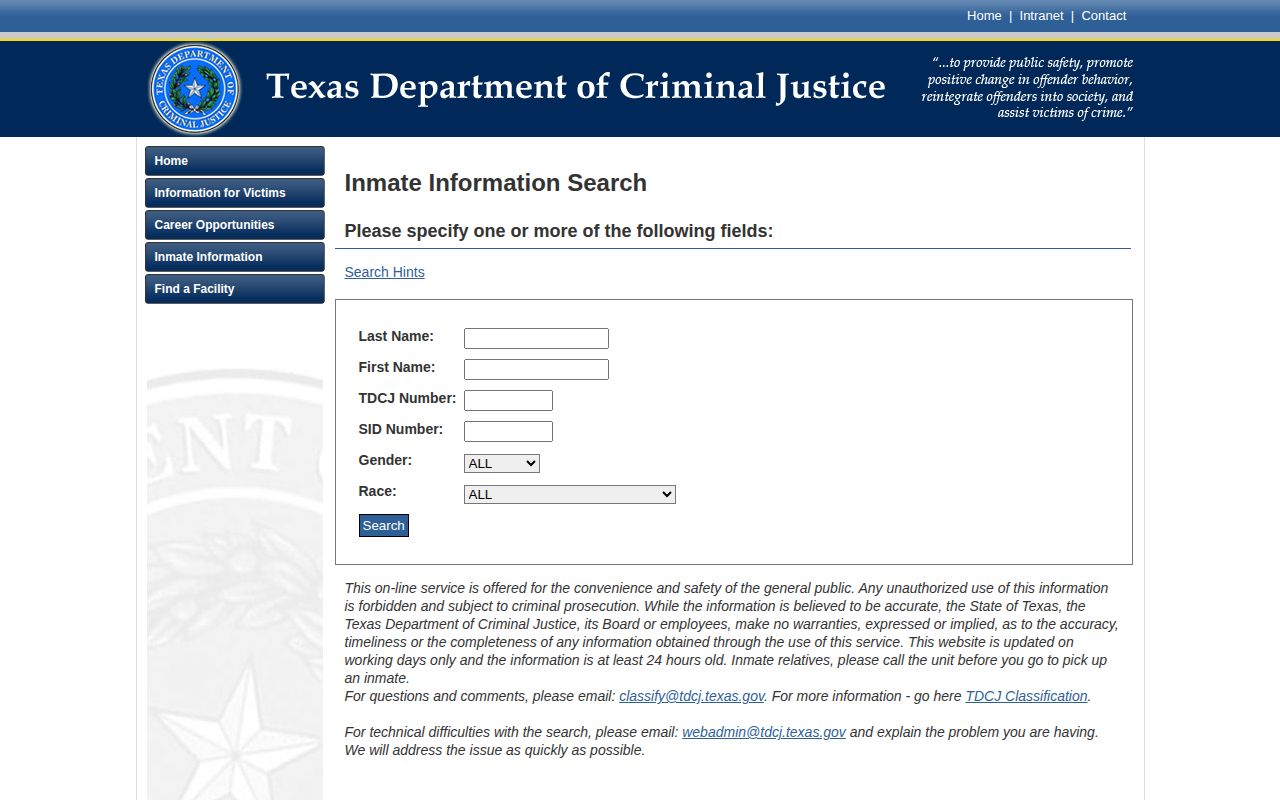
That limitation is why a dated TDCJ release or discharge record becomes the main historical source for a former state prisoner.
Uvalde County Recent Release Search
The official sheriff page offers contact details but no web roster, archive, app, or 24-hour and 72-hour feed. A date-bounded request is the accurate substitute. Ask for people whose release or transfer timestamps fall inside the exact interval, and ask the sheriff to separate community releases from transfers. The Uvalde County 24-Hour Releases page focuses on this same-day records workflow.
Offline retention makes the request worthwhile. The Texas State Library schedule makes the jail register permanent and keeps supporting booking and release or transfer records for at least two years after departure. Actual retention may be longer. Online visibility cannot be measured because no official online release view exists.
Getting Home After Uvalde Release
Southwest Area Regional Transit District publishes Uvalde route and microtransit information. No official source promises a stop at the correctional facility or service timed to an unpredictable release. A family member planning a pickup should confirm the release with the jail and contact SWART about current routes before travel. A planned release time can shift while staff resolve holds, property, paperwork, or a receiving agency.
The same caution applies to state-prison release. A scheduled TDCJ location can change, including on the planned day. Confirm close to travel rather than treating a projected or scheduled field as a completed gate event.
Uvalde Post-Release Supervision Records
Parole and probation lead to different offices. TDCJ parole follows state incarceration and is overseen by the Board and Parole Division. The official county crosswalk assigns Uvalde County to the Del Rio District Parole Office, although residence approval, transfer, and specialized caseloads can change an individual assignment. County probation is imposed by a court and administered through the local Community Supervision and Corrections Department.
Uvalde also has a community-corrections treatment facility within the local CSCD structure. Leaving that residential program may mean completion of the treatment placement while court-ordered supervision continues. Confirm the court docket and CSCD status. The distinction between residential completion and full discharge is covered with parole verification on the Uvalde County Post-Release Supervision page.
Uvalde County Release Alerts
Legacy Texas county VINE ended on September 1, 2025. The current county notification service is Texas IVSS-Counties. It can search people in participating custody or supervision and accept event registrations, but Uvalde participation must be confirmed in the live portal or at 866-268-8959. A person outside its display scope may produce no result. State-prison custody, parole, and mandatory-supervision alerts use a separate TDCJ IVSS account.
Was Uvalde Release a Federal Transfer?
The county audit says the 214-bed correctional facility houses local, area, and United States federal prisoners. That makes a departure from Uvalde custody unusually ambiguous. A release entry can describe an interagency pickup rather than a return to the community. Ask the sheriff for the destination and receiving agency before selecting a federal search.
For federal imprisonment, BOP's locator can retain a past release date and a Released or Not in BOP Custody status. USMS has no public prisoner locator. ICE's locator includes some releases for 60 days, but not every person. A county record that says federal transfer should first identify whether BOP, USMS, ICE, or another county took control.
Where Uvalde Release Records Appear
No single portal covers every Uvalde departure. Choose the source by custody status and system. A current roster answers a different question from a release certificate, and a court judgment answers a different question from both.
| Situation | Best source | What it proves |
|---|---|---|
| Still in Uvalde jail custody | Sheriff direct confirmation | Current county custody at the time checked |
| Released or transferred from county jail | Jail register and booking-out record | Departure time, type, and possible destination |
| Currently in state prison | TDCJ Inmate Search | Lagged current incarceration and projected fields |
| Former state prisoner | TDCJ release or discharge record | Actual state release and later discharge status |
| County probation | Court docket and CSCD | Placement, modification, revocation, or completion |
| Federal imprisonment | BOP locator and federal docket | BOP status and reported release date |
Uvalde County Release Facilities
Two local facilities require distinct release paths. The Uvalde County Correctional Facility is the sheriff-operated jail for local, area, and federal prisoners. Its release proof comes from the sheriff record, court cause, and any receiving agency. The Uvalde Community Corrections Facility is an 80-bed residential treatment placement in the CSCD setting, not a second county jail. Completion there may return a resident to community supervision rather than end the case.
No TDCJ prison unit, BOP institution, or dedicated ICE facility was identified in Uvalde County. A Uvalde conviction can lead to a TDCJ unit anywhere in Texas, and federal placement can occur elsewhere. Search the statewide or federal system named in the transfer record rather than assuming the nearest institution holds the person.