
Uvalde CCF Release Meaning
Official county materials place the Uvalde Community Corrections Facility within the 38th and 454th Judicial Districts Community Supervision and Corrections Department structure. TDCJ's residential materials also identify it as Uvalde CRTC or Uvalde CCF. Its role is residential treatment for specified felony, misdemeanor, and pretrial placements. It does not perform the same booking and release function as the sheriff's county jail.
“Release” from Uvalde CCF commonly means completion or discharge from the residential phase. The person may then resume probation in the community, move into another program, receive modified conditions, or remain subject to the sentencing court. A revocation can instead return the person to custody. Only the CSCD and court record can show which path applied to one resident.
Completion of a Uvalde CCF placement does not by itself mean the criminal case or community supervision has ended.
Confirm Uvalde CCF Discharge Records
Start with the court cause and the Uvalde County CSCD. Ask for the order that imposed the placement, any program completion or discharge documentation that is public, and the current supervision status. The cause number is more reliable than a broad name search because one person can have more than one case or supervision term.
- Identify the cause number, sentencing court, and placement order.
- Call the Uvalde County Adult Probation office to verify the correct supervising unit and whether an in-person records route is available.
- Request the docket entries for placement, modification, completion, transfer, revocation, and discharge.
- Distinguish residential completion from final discharge from supervision.
- If a later order commits the person to jail or TDCJ, follow that custodian's release record.
The county's official online-records instructions describe guest access and document-image steps. Search the right court. The District Clerk holds district criminal pleadings and papers, while the County Clerk and justice courts hold matters within their own jurisdiction. A docket event may establish a legal change, but the CSCD confirms how supervision is being administered.
For the broader distinction between custody release and court supervision, use the Uvalde County post-release supervision page. It separates parole, which follows prison and is handled through TDCJ, from probation, which is imposed and overseen through the court and CSCD.
Uvalde CCF Contact Details
The residential list places Uvalde CRTC at 401 East Front Street. Contact listings can change, so confirm placement information before visiting. The county Adult Probation page is the current local supervision contact. It lists Director Todd Winslow, 123 East Nopal, and 830-278-6671.
Uvalde Community Corrections Facility / CRTC401 East Front Street
Uvalde, TX 78801
Placement details: confirm through Uvalde County CSCDUvalde County Adult Probation
123 East Nopal
Uvalde, TX 78801
830-278-6671
Call before visiting
TDCJ-CJAD's residential list gives 117 East Nopal for the CSCD administrative office, while the official county Adult Probation page gives 123 East Nopal. Do not choose between those street numbers for travel without checking. Call 830-278-6671 first and ask which entrance or office currently handles the request.
Uvalde Treatment Facility Facts
The TDCJ-CJAD residential-facility list describes an 80-bed program, with funded capacity divided into 20 female and 60 male places. It identifies the facility as operational since April 1991. These figures establish the size and program context, not the presence, completion date, or discharge of any named resident.
The county sheriff facility is separately described as a 214-bed detention site. The two figures should never be merged. The CCF provides a treatment and supervision placement; the county correctional facility confines local, area, and some federal prisoners. Their records, release meanings, and responsible offices differ.
| Uvalde facility | Primary role | Best status record |
|---|---|---|
| Community Corrections Facility | Residential treatment within CSCD supervision | Court order, docket, and CSCD status |
| County Correctional Facility | County jail detention and contract housing | Sheriff booking-out or transfer entry |
| TDCJ unit elsewhere | State prison or state-jail custody | TDCJ custody and release certificate |
Uvalde Supervision After Completion
Probation permits a person to remain in or return to the community under court-set terms. The CSCD administers those terms for the court. Residential treatment can be one condition within a longer probation term. Program completion may therefore change where the person lives without ending reporting, treatment, payment, travel, or other lawful conditions recorded in the case.
A later docket can show modification, successful completion, early termination, regular discharge, or revocation. “Discharge” should be tied to the specific document. A discharge from the residential program is not necessarily a discharge from probation. Likewise, an absconder or warrant notation may show enforcement action after a prior community return; it does not erase the earlier release from the residential setting.
- Probation
- Court-ordered community supervision that can include residential treatment.
- Placement
- An order assigning a person to a program or facility under stated terms.
- Completion
- Finish of a program component, which may leave supervision in effect.
- Revocation
- A court action ending community supervision and imposing another result.
- Discharge
- The documented end of the obligation named in that record.
Use exact dates and labels from the order. Do not infer successful completion from a person's absence from a program list, and do not infer final discharge from a move back into the community.
Uvalde Court Record Route
Felony district causes belong with the 38th Judicial District Clerk at Courthouse Plaza, Box 15, Uvalde, Texas 78801, 830-278-3918. The County Clerk handles county-level records at 100 North Getty Street, first floor, and 830-278-6614. Its published hours are generally 8:00 a.m. to 4:30 p.m., open through lunch. Justice courts keep the lower-level matters assigned to them.
Read the charging instrument and cause number before selecting an office. Useful entries include the original placement, pretrial conditions where applicable, judgment, probation conditions, later modifications, completion reports, revocation filings, orders, and satisfaction or discharge. One case can close while another remains active, so review each cause separately.
A court record is durable but may lag the physical transition from the facility. Pair the order with CSCD confirmation. The official Adult Probation page supplies the local contact, while TDCJ-CJAD sets statewide standards and maintains the residential listing.
Uvalde CCF Versus TDCJ
Uvalde CCF is not a TDCJ prison unit. TDCJ-CJAD oversees standards and funding relationships for local community-supervision departments, but that does not convert a CSCD residential placement into state-prison confinement. The statewide TDCJ inmate search may therefore be irrelevant to a person who completed CCF and remained on county probation.
If the court later commits the person to TDCJ, the state path begins. The public TDCJ search shows current incarceration but drops people after release. Historical confirmation then requires a release or discharge certificate and an information request. A transfer between prison units remains custody, just as movement from CCF to the county jail is not a community release.
Note: Name the custodian whose control ended, since “released” has a different record meaning in treatment, county jail, and state prison systems.
Uvalde CCF Visual Source
The Uvalde County Adult Probation page provides the official local contact used to verify supervision after a residential placement.
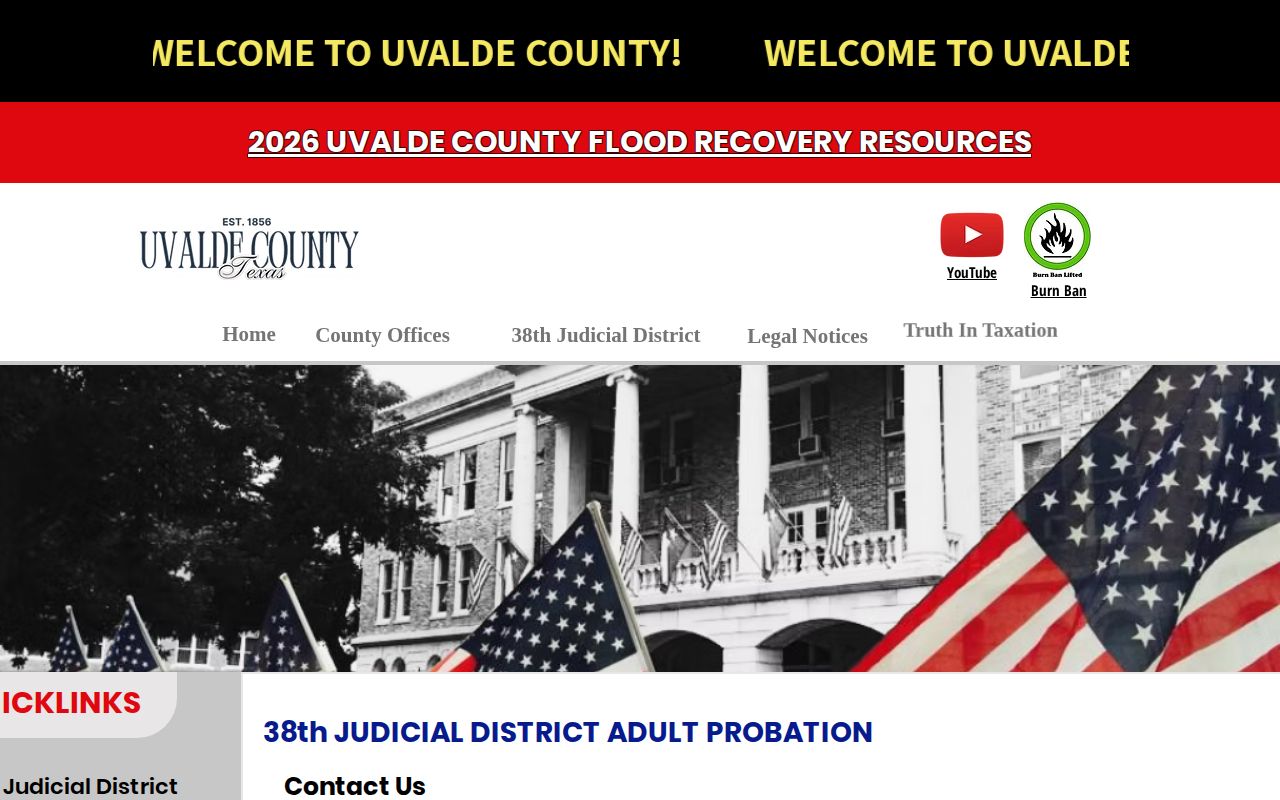
The captured page supports the contact route, not an individual's placement or discharge. Personal status still requires the correct court cause and CSCD confirmation.