
Uvalde Parole Versus Probation
Parole follows incarceration in the Texas Department of Criminal Justice. The Texas Board of Pardons and Paroles makes the release decision, while the TDCJ Parole Division handles release processing and supervision. Mandatory supervision is also a TDCJ status after prison, but it follows a distinct statutory path. Probation, formally called community supervision in Texas, is imposed through a court and administered by a local Community Supervision and Corrections Department, or CSCD. It may begin without any TDCJ prison term.
A person can leave the Uvalde County Correctional Facility on a probation judgment. Another can leave a TDCJ unit on parole. A resident can also complete treatment at the Uvalde Community Corrections Facility while court supervision continues. The record custodian changes with each route. Use the court and Uvalde County CSCD for probation. Use TDCJ and its Parole Division for parole or mandatory supervision.
| Status | How it begins | Verification source |
|---|---|---|
| Parole | Board-authorized release from TDCJ incarceration | TDCJ Parole Division and Board status |
| Mandatory supervision | Statutory release from TDCJ, sometimes subject to discretionary Board review | TDCJ release and supervision records |
| Probation | Community supervision ordered by a Texas court | Sentencing court and Uvalde County CSCD |
| Residential placement | Court or CSCD placement at Uvalde CCF/CRTC | CSCD, facility completion record, and court docket |
- Discharge
- Completion of the sentence or supervision obligation, not merely departure from a jail or program.
- Absconder
- A person alleged to have stopped reporting or left supervision without authorization.
- Detainer
- A request by another authority that can prevent community release or lead to transfer.
Check Uvalde Post-Release Status
Begin with a name, date of birth, and any SID, TDCJ, booking, or court cause number. Identifiers help separate people with similar names. Then establish the custody path. The public TDCJ inmate search covers current state prisoners, not a historical list of people who have been released. A missing result does not establish discharge. For an actual prior release, request Parole Division information or the release and discharge certificate.
Follow a record chain instead of relying on one status screen:
- Check the TDCJ Inmate Search for present state incarceration and identifiers.
- For parole review status, call 844-512-0461 with the name, TDCJ number, and date of birth. After a favorable vote, Review and Release Processing is reached at 512-406-5202.
- For probation, use the sentencing cause and contact Uvalde County Adult Probation.
- Ask for the exact status, supervising unit, warrant information if public, and discharge date. Verify a claimed end of supervision against the docket or agency record.
The result should answer both parts: whether physical custody ended and whether supervision remains. A jail release entry proves movement from the jail. It does not identify every later supervision change.
Uvalde Probation Office Records
The county's current Adult Probation page lists Director Todd Winslow and gives 123 East Nopal as the office address. A TDCJ-CJAD residential-facility list gives 117 East Nopal for the CSCD administrative office. Because two official sources differ, call before making an in-person trip. The shared local number is the best way to confirm which entrance or office now handles the case.
123 East Nopal
Uvalde, TX 78801
830-278-6671
Call to confirm the current street number and service hours.
Ask the clerk or CSCD for the cause number, court, supervision order, current unit, modification or revocation activity, and completion status that may be released. A court docket can show a judgment, later order, or motion. The CSCD record addresses administration of supervision. Neither should be replaced by an old jail roster entry.
Texas probation is not controlled by the Board of Pardons and Paroles. Sending a local probation question to the Board can produce no useful match even when supervision is active. Start with the court that imposed community supervision and the CSCD that carries it.
Del Rio Handles Uvalde Parole
Uvalde County has no district parole office in the TDCJ county crosswalk. The official assignment is the Del Rio District Parole Office in Region IV. This is a distinctive local routing point: the office is outside Uvalde County. Residence approval, a specialized caseload, transfer, or a later move can alter an individual's reporting site, so verify the assignment before travel.
903 East 12th Street
Del Rio, TX 78840
830-775-4516
Fax: 830-774-0736
Confirm the crosswalk through the TDCJ county parole-office list and current details in the Region IV directory. General parolee location, supervision, or conduct questions may also go to io@tdcj.texas.gov. Public-record requests for Parole Division records go to pia@tdcj.texas.gov.
Texas Parole Reviews Are Files
Texas does not conduct a formal hearing for ordinary parole or mandatory-release consideration. Panel members review and vote on the file individually. There is no Uvalde County parole-hearing calendar to search, and a review month should not be labeled a hearing date. TDCJ generally identifies cases about six months before initial eligibility and about four months before a later review. An Institutional Parole Officer interviews the person and prepares a summary for a three-member panel.
Two matching panel votes decide the matter. A third member resolves a split when needed. An approval can name a future month, require transfer or treatment, or add conditions. A denial sets a later review framework. The Board vote-options glossary defines FI-1, FI-2, program variants, RMS, NR, DMS, and other codes. A favorable FI result remains a decision, not proof that the person crossed the gate.
The official parole panel page describes the review process shown below.
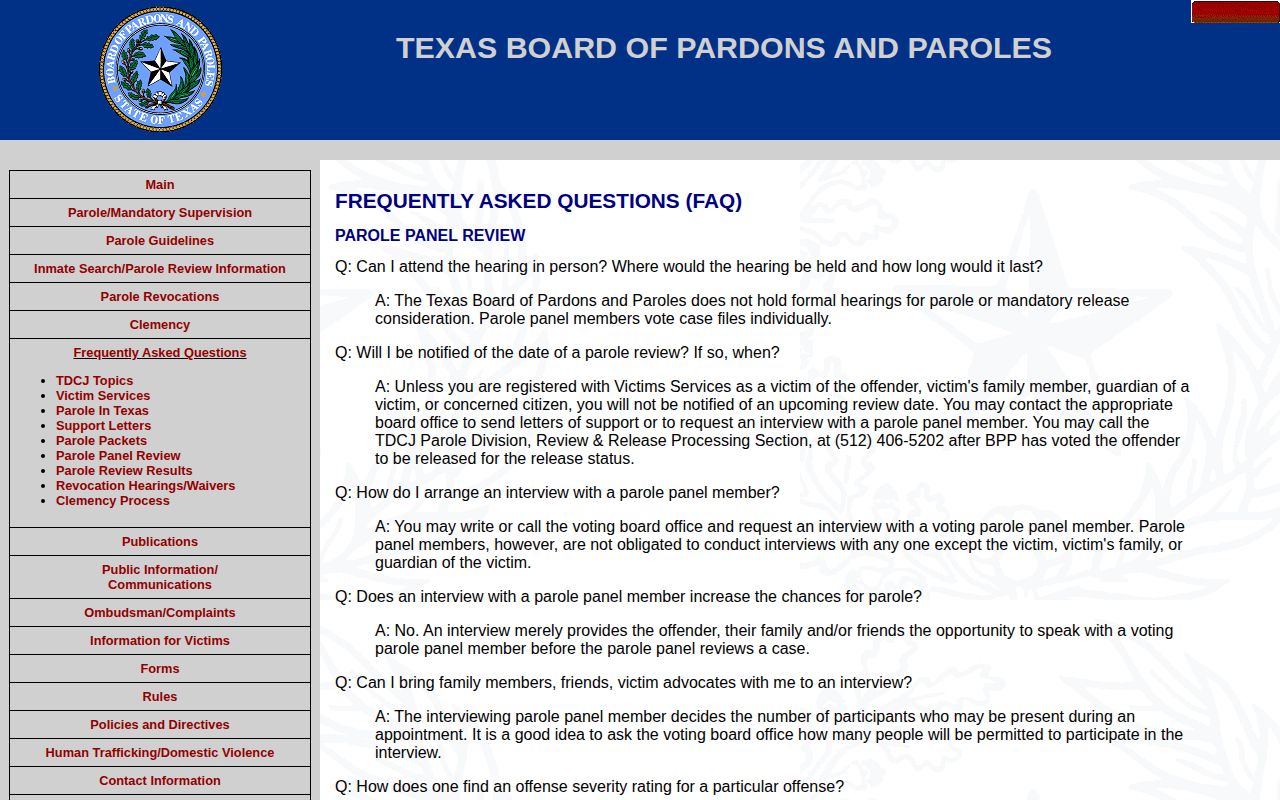
The captured page supports the key distinction between a file review and a courthouse-style hearing.
Uvalde Supervision Violations
Conditions can include reporting, approved residence, travel limits, treatment, fees, or other case-specific duties. The signed supervision order controls. An absconder or warrant notation means enforcement may be pending. It does not erase the earlier physical release, and it does not by itself show that the person has returned to custody. Ask the supervising agency for public status and warrant data, then confirm a new arrest with the custodian that made it.
TDCJ policy identifies parole or mandatory-supervision status and warrant number and date among information that may be requested, subject to protected redactions. Uvalde County does not publish a verified, complete local absconder list. A wanted post or social update cannot stand in for the agency record.
For a future custody or supervision event, VINE Inmate Check explains Texas IVSS notifications. County IVSS and TDCJ IVSS have different scopes. A notice is useful near the event, but reconcile it with the release certificate, warrant record, or jail booking entry.
Uvalde CCF Completion Status
Uvalde has a local residential community-corrections footprint. The TDCJ residential portal lists Uvalde CRTC/Uvalde CCF for felony, misdemeanor, and pretrial placements. County material places the Community Corrections Facility in the 38th and 454th Judicial Districts CSCD structure. It is not the county jail and not a TDCJ prison unit.
Leaving the residential program can mean treatment or placement completion while a court order remains active. Verify the facility departure with CSCD, then read the underlying docket for continued reporting, modified conditions, transfer, revocation, or final completion. The state facility list describes the Uvalde CRTC at 401 East Front Street with funded capacity for 80 residents. Capacity does not prove that a named person entered or completed the program.
A completion certificate answers a narrower question than a supervision-discharge record. Keep both when the goal is to document the full post-release sequence.
End Uvalde Release Supervision
Physical release, supervision discharge, and case closure can occur on different dates. For parole or mandatory supervision, request the actual release date, current status, and discharge date from TDCJ. For probation, obtain the court's completion or discharge order and confirm the CSCD record. If residential treatment was involved, keep its completion record with the later court and CSCD documents.
The most reliable evidence names the status and custodian. The Uvalde County released-inmate search path explains how the original jail release or transfer record fits beside court and supervision records. If TDCJ holds the record, its Public Information Act process can be used to request a release or discharge certificate. A current-search no-result is not an adequate substitute.
Note: A completed residential placement may still be followed by court-ordered probation in Uvalde County.